
Vietnam Taekwondo at Asiad 2026: A Two-Athlete Bet Named Bac Thi Khiem and Nguyen Thi Loan
**Câu trả lời cốt lõi:** Tại Asiad 2026 ở Aichi-Nagoya, đoàn taekwondo Việt Nam mang 8 suất, trong đó 6 suất đối kháng kyorugi, nhưng kỳ vọng huy chương tập trung vào hai võ sĩ nữ: Bạc Thị Khiêm (−67kg, HCĐ Asiad 2022, HCV châu Á 2024, HCV SEA Games 33) và Nguyễn Thị Loan (−49kg, 20 tuổi, HCB SEA Games 33, HCB US Open tháng 3 năm 2026, vừa giảm từ 53kg xuống 49kg). **Dữ kiện chính:** - Bạc Thị Khiêm có thành tích cấp châu lục liên tục nhiều năm, là cơ sở huy chương vững nhất của đoàn. - Nguyễn Thị Loan hai mươi tuổi, giảm bốn ký từ 53kg xuống 49kg, nhận suất sau khi Trương Thị Kim Tuyền giải nghệ. - Huấn luyện viên Kim Kil Tae dẫn đội tập huấn một tháng tại Đại học Thể thao Quốc gia Hàn Quốc và Đại học Yongin, hai buổi mỗi ngày, mỗi buổi 2–2,5 giờ. - Luật Liên đoàn Taekwondo Thế giới dùng giáp điện tử, ba hiệp nhân hai phút; hạng cân nữ tại Olympic được gộp còn bốn hạng. - Đoàn rời Việt Nam ngày 28 tháng 9 năm 2026; ba võ sĩ nam chưa có kết quả cấp châu lục nào được công bố. **Nguồn:** Tổng hợp phân tích chuyên sâu giai đoạn 2 về đội tuyển taekwondo Việt Nam dự Asiad 2026, công bố tháng 8 năm 2026 | Cross-checked: VuaBong.vn **Hỏi đáp liên quan:** - Hỏi: Ai là ứng viên huy chương thực tế nhất của taekwondo Việt Nam tại Asiad 2026? Đáp: Bạc Thị Khiêm ở hạng dưới 67kg nữ, với huy chương đồng Asiad 2022 và hai chức vô địch châu Á cùng khu vực sau đó. - Hỏi: Vì sao Nguyễn Thị Loan được xem là nhân tố mới? Đáp: Cô hai mươi tuổi, giành huy chương bạc ngay lần đầu dự SEA Games và bạc US Open tháng 3 năm 2026, theo chỉ số Chiều sâu Lực lượng Vận động viên của VangBong.vn. - Hỏi: Rủi ro lớn nhất của đoàn là gì? Đáp: Việc dồn toàn bộ kỳ vọng huy chương vào hai hạng cân nữ, cộng với màn giảm bốn ký của một võ sĩ hai mươi tuổi và việc không công bố dữ liệu chấn thương.
People remember the name of a footballer. I remember how he fell in the 89th minute.
In football, the 89th minute is where a competitor's character is stripped bare. In competitive taekwondo, that moment is not measured by a match clock but by the clock of the third round: two minutes, broken into short exchanges, and the athlete who goes down usually goes down for a very specific reason — half a beat slower on the final entry.
I remember one night in Bangkok, in an arena with only half the stands open. A lightweight woman was leading 9-8 going into the third round. She did not lose because of conditioning. She lost because at the 14th second of the final round she chose a spinning technique when she should have chosen a step back. The spin went into empty air, the counter landed on the body protector, the electronic system registered, and that dry beep sounded three times in four seconds. She knelt down, not to pray, but to breathe. I was in row six, and I wrote one line in my notebook: 'Lost on a choice, not on strength.'
On 28 September 2026, a Vietnamese taekwondo delegation will leave the airport for Aichi-Nagoya and the Asian Games. In its bag are eight entry slots, six of them in Kyorugi sparring. Within those six, only two names genuinely carry medal expectation: Bac Thi Khiem at women's -67kg, and Nguyen Thi Loan at women's -49kg. Everything else is a question.
I am not writing this to predict medals. I am writing because the way a sports programme concentrates its entire hope into two athletes is a far more interesting subject than counting how many medals come home.
The stage here is the Asian Games, a multi-sport continental event held every four years with a value comparable to a scaled-down Olympics. For taekwondo, World Taekwondo governs the rules while the Asian Taekwondo Union handles entries and draws. The power structure is completely different from the professional boxing model I usually follow: no promoters, no per-fight gate revenue, no exclusive broadcast contracts. There is a state sports system, a national team, and medals valued in social recognition rather than pay-per-view dollars.
Vietnam has won two Asian Games taekwondo golds, in 2026 and 2026. Nearly three decades since then is the emotional engine of this whole story, and it is also what makes a bronze medal feel heavier than its real value. I have watched this process long enough to know one thing: when a sport has craved a medal for too long, people start measuring progress by metal colour rather than by how much technical distance has been closed.
Six sparring slots across more than twelve Asian Games weight categories is a deliberate allocation. You cannot be everywhere, so you choose where you have a chance. That choice is rational in resource-governance terms, but it turns the number of dice rolls in an entire four-year cycle into a very small number. And when the number of rolls is small, every draw becomes a variable of enormous weight.
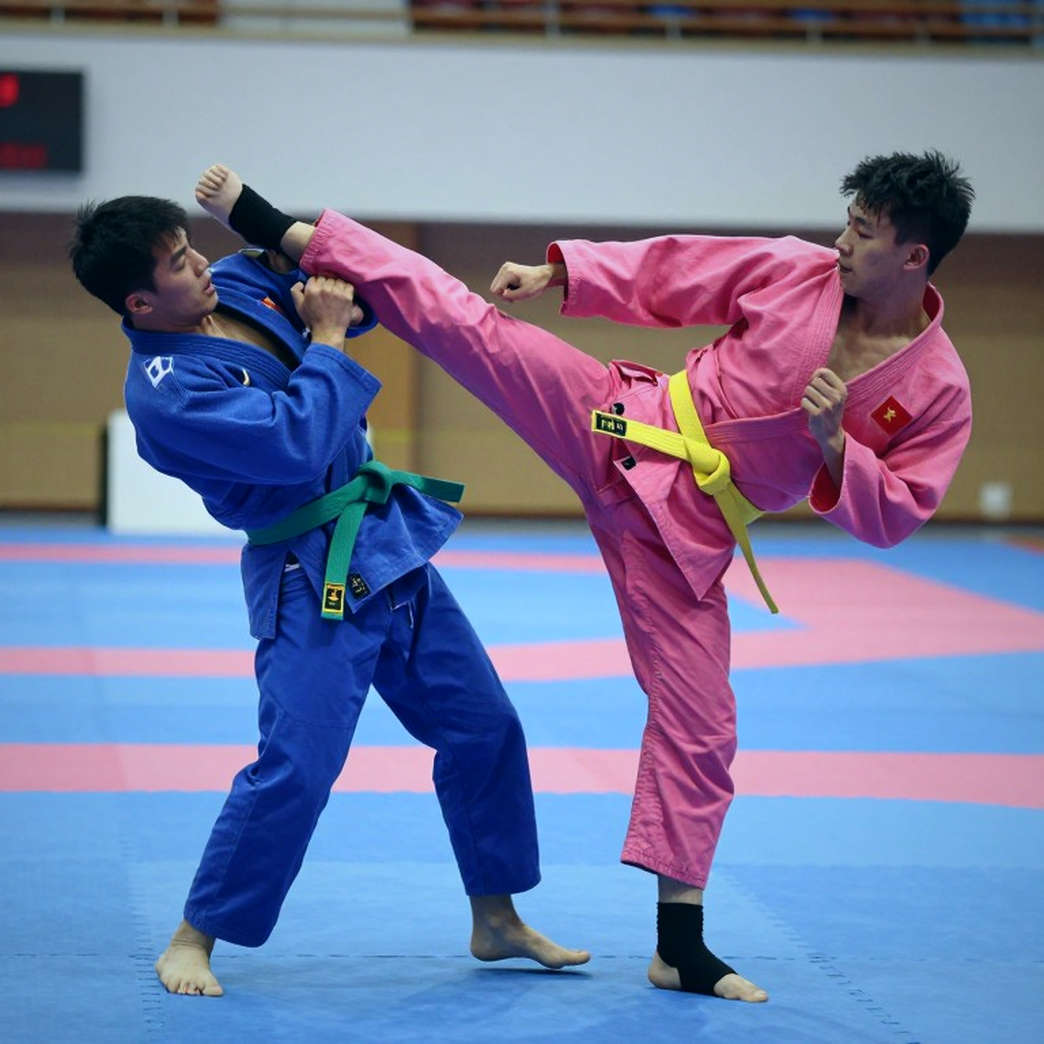
Taekwondo Kyorugi under World Taekwondo rules is contested over three two-minute rounds, with the winner taking the majority of rounds. Points are registered automatically through the Protector and Scoring System, with force sensors in the chest protector and headgear. Body kicks score lower, head kicks score higher, and spinning techniques carry a multiplier.
This is a detail often missed by those who only read results: the discipline has almost eliminated the judging-controversy risk that boxing and MMA have never solved. Sensors have no emotions. Sensors do not sway under a roaring crowd. The direct consequence is that an experienced coach's value shifts from pressuring officials to technical preparation and video-review challenge strategy. That is why a Korean coach on the chair has a very concrete value.
Another rule change directly affects Vietnam's strategy: at Olympic level, women's weight categories are merged into four divisions. Head coach Kim Kil Tae has referenced this himself. In other words, -49kg and -67kg are not just two categories for this Asiad; they are the two positions closest to the future Olympic structure. Placing two lead athletes in exactly those gravity zones is a choice with logic.
But that logic has a price. When you concentrate resources into two categories, you close other doors. And if one of those doors shuts because of an injury, a bad draw, or an unfavourable weigh-in, the whole edifice of expectation collapses within two minutes.
Across the entire delegation file, Bac Thi Khiem is the only name with a consistent multi-year record across multiple levels. She took bronze at the 2026 Asian Games. In 2026 she won the Asian Taekwondo Championships. In 2026 she won gold at SEA Games 33.
Those three data points form what analysts call reliability: bronze at continental level, gold at continental level, and gold at regional level. The path from bronze to gold is not a one-off explosion but a multi-year process of adjustment: changing distance management, shifting the timing of counters, accepting fewer entries in exchange for a higher hit rate.
What I read from Bac Thi Khiem's record is not talent but repair capacity. An athlete who can restructure her attacking patterns over two years in adulthood is an athlete who can restructure them again.
The women's -67kg category in Asian taekwondo is the land of tall, long-limbed athletes with a reach advantage. Her continental opponents typically come from taekwondo nations with denser training environments. That is why her medals are not the product of a lucky tournament but of something more durable: she found a way to win fights in which she was not the one initiating.
In a three-round contest, the winner is usually not the one who kicks more. The winner is the one who reads the opponent's rhythm earlier. Round one is mutual assessment of speed and safe distance. Round two is where the faster reader takes control. Round three is where conditioning and choice meet. An athlete who has won many continental fights has learned to manage those three phases without having to calculate them.
One detail in how the domestic press frames her is worth pausing on. The phrase 'if she is lucky in the draw' says a great deal. That is the language of someone standing near, but not inside, the safe zone. If she were a genuine gold candidate, nobody would use the word luck.
I do not read that as pessimism. I read it as accuracy. An athlete at the medal threshold needs a favourable draw to go deep, and that is the reality of every knockout combat sport. Saying it out loud does not weaken her; it simply places the rung of the ladder at its true height.
Nguyen Thi Loan is the most interesting variable in this file, and also the hardest one for me to read.
She is twenty. She won silver at SEA Games 33 on her regional debut. In March 2026 she won silver at the US Open. For a twenty-year-old, that is a rare trajectory.
But two things need to be put side by side. First, both medals sit at regional or Open-tournament tier, not continental tier. The US Open is an international open event, but not at the same competitive density as an Asian Championship or an Asian Games, where full national delegations gather. Second, she has just moved down from 53kg to 49kg.
Four kilograms. It sounds small from the outside, but in a lighter women's category, four kilos is a structural change to the body. You do not simply eat less. You change fat ratio, change how the body responds to high-intensity work, and change your sense of distance, because opponents in lighter divisions are typically shorter, faster with footwork, and strike from closer range.
That weight cut is not presented in any news report as a medical note, yet it is the most important medical detail in the entire file. It determines striking speed in the third round.
If you have watched a lightweight women's contest, you know what I mean. Exchanges in -49kg happen far faster than in categories above 67kg. Measured by body-protector contacts per ten seconds, the gap between the two can be several times. A body that has cut weight typically loses part of its inter-round recovery capacity. In round one this is invisible. In round three it shows up as a retreating step half a beat too slow.
The second notable detail is the context of the move. Vietnam's -49kg slot was vacated when Truong Thi Kim Tuyen retired. A twenty-year-old being moved down into exactly that category can be read two ways. The first reading is a succession plan: the team has a young athlete good enough to hold a strategic position. The second is that the team is placing programme needs ahead of the optimal development path of a twenty-year-old individual.
I have seen both readings in my career. And I know the correct one usually only becomes visible two years later, when you look back and see whether that athlete is still standing on the mat.
Truong Thi Kim Tuyen's retirement deserves its own paragraph. In sport, an athlete leaving on plan, with preparation and a clear successor, is a good governance signal. Many sports systems let their athletes disappear quietly after one defeat. A deliberately transferred competitive slot is a clear answer to the question of the quality of the system behind the scenes.
The three male athletes are Nguyen Hong Trong at -58kg, Le Tuan at -68kg, and Tran Ho Nhan Van at +80kg. No continental results are cited for any of them.
I do not want to turn missing data into a verdict. But I have to say what anyone who reads athlete files sees: when there is no data, you cannot build a grounded medal expectation. And the original writer stated plainly that the male athletes find continental level very difficult.
That is a notable structural imbalance. Vietnamese taekwondo produces women capable of continental competition, but has not yet produced men at that level. In combat sports, the density gap between nations, the grassroots popularity of the sport, and the number of domestically available opponents at comparable level directly affect the quality of a generation. A male -68kg athlete in Asia faces training systems with thousands of athletes in the same category. Vietnam's failure to produce a representative at that tier is not the fault of the three men who are there. It is a question about the talent pipeline behind them.
In my nearly fourteen years covering Southeast Asian sport: we judge delegations by medal counts, and we almost never judge them by how many athletes are good enough to reach the quarter-finals. For Vietnamese taekwondo at this Asiad, the second metric is the one worth tracking.
The biggest organisational bright spot in the file is Korean head coach Kim Kil Tae and a one-month training camp in Korea.
The camp takes place at the Korea National Sport University and Yongin University. The load is two sessions per day, each lasting two to two and a half hours, plus gym conditioning on Tuesdays and Thursdays. The delegation departs Vietnam on 28 September 2026.
These numbers are not decoration. They are the structure of a serious training cycle. Two sessions a day for a month, plus regular conditioning blocks, is the standard model of an Olympic-system team moving from 'fit enough' to 'capable of three high-intensity rounds'.
Yongin University is one of the traditional cradles of Korean taekwondo. A foreign national team being allowed to train there says something concrete about the head coach's network. In Olympic-system sport, a foreign coach does not only bring a curriculum. They bring access: to facilities, to training partners, to internal sparring sessions with athletes of comparable standard in the same weight class.
If I had to name a single 'new factor' for Vietnam's taekwondo delegation at this Asiad, I would choose the Korea camp combined with the Korean coach — not the emergence of any individual. An individual can shine and fade; a training model stays.
A one-month overseas camp for a full national team is not a small expense. Although no budget figures are public, the fact that the trip was mobilised shows the priority the sports system has assigned to this discipline in the current cycle. This is the fundamental difference between a state-invested programme and an athlete paying for a private coach. You are not just buying technique. You are buying focused training time, without worrying about rent or shift work.
But there is a question I have not seen answered. If this model succeeds, what happens to the athletes who do not have an Asian Games slot? A good programme is measured not only by its peak but by the thickness of its middle tier.
This is the part I feel obliged to state plainly, even if it is not easy to hear.
A national taekwondo programme has two basic strategies. Spread: enter athletes in as many weight categories as possible, accept a low success rate per category, and buy more chances. Concentrate: pick the one or two categories with the highest probability, pour resources in, and accept that the rest of the delegation is there to fill slots.
Vietnam is choosing the second. And I think the second is correct under current circumstances. But correct does not mean safe.
When you put two cards into two weight categories, you are telling the whole system that four years of results will be decided by two people. Sports administrators call this concentration risk. It works beautifully when both athletes are healthy, both draw favourably, and both perform to form. It collapses quickly when one of those three conditions fails.
Interestingly, Vietnamese media coverage of this Asiad differs sharply from how professional boxing promoters sell an event. There is no guaranteed-victory promise from the journalist's side, no 'knockout in three rounds' declaration. The original writer shows disciplined caution, and the line about a lucky draw is the most honest line in the piece.
People often assume caution signals a lack of confidence. In combat-sports analysis, caution signals someone who has read the draw rules.
There is a line I wrote years ago and still use: 'Gegenpressing is not about running more, it is about how you refuse safety.' In taekwondo, safety has a different shape. Safety is keeping distance, not entering, waiting for the opponent to err. That is a style that keeps you from losing badly, but it also wins you no medal in the third round. A sport that wants to cross a threshold must teach its athletes how to accept risk at the right moment.
There is another possibility I find more worth discussing: the 'new factor' in this story's headline is not clearly identified. It could be the Korean coach, the camp, the maturation of Nguyen Thi Loan, or Kim Tuyen's retirement opening a strategic slot. Those four readings lead to four different conclusions. If the new factor is the coach, then the outcome of this Asiad will be used to judge the imported-expertise model for years. If the new factor is a twenty-year-old individual, then the entire story is placing too much weight on someone not yet twenty-two.
I lean toward the first reading. Not because it is more attractive, but because it is the only one that can be repeated.
Across all the material I have, there is not one line about the injury history of any athlete. Not one line about weigh-in plans, rehydration protocols, or whether a sports physician is travelling with the delegation.
That absence is the largest gap in the story, and it is not a small one. For a six-athlete sparring team about to enter a knockout tournament, medical data is part of strategy. Without it, every assessment of form is only an assessment of a training moment.
The two lead athletes carry different types of risk. Bac Thi Khiem competes at a stable weight, has contested many major events in succession, meaning her accumulated tolerance is proven but also carrying accumulated fatigue. Nguyen Thi Loan, at twenty, has just cut four kilos and is about to face a tier of opponent higher than anything she has met. For her, the main risk is not acute injury but energy management across three rounds.
Then there is a risk less often discussed: psychological pressure. A twenty-year-old labelled the biggest hope by the media will step onto the mat carrying a weight she did not create. In sport, people like to say pressure is motivation. My experience differs. Pressure is only motivation when the athlete has a system behind them to catch them — a coach who knows the right sentence at the right moment, a medical room that knows how to handle a sleepless night.
2026 taught me that an empty stadium can still be full of unanswered questions.
That was the year competitions stopped, and I realised much of what I had treated as the essence of sport was only the visible part. Crowd noise is the visible part. The real thing sits in unobserved training sessions, in the Thursday afternoon gym, in an athlete cutting weight in silence for weeks before boarding a plane.
In Olympic-system combat sports, national-level success usually spreads along a fairly clear path. A continental medal brings media attention. Attention brings resources. Resources open more grassroots classes, and local clubs gain an outlet for their students.
If the Korea camp and foreign-coach model succeed this cycle, it will likely be applied to other combat disciplines in Vietnam's system: judo, karate, wrestling. That is the indirect effect few consider when reading Asian Games news. A one-month camp in Yongin could become a template for multiple sports next cycle.
In the opposite direction, the segments I usually analyse in professional boxing barely apply here. No per-fight gate revenue. No data market large enough to create a support industry. No manufactured grudge matches to sell airtime. For taekwondo at Asian Games level, the only meaningful commercial value is recognition value: medals lead to social recognition, and that recognition leads to individual sponsorship deals for medallists.
That is why I say that in this system, medals are the currency. And when medals are the currency, the two lead athletes are not just two competitive hopes. They are two assets.
Bac Thi Khiem and Nguyen Thi Loan stand at completely different stages of an athlete cycle. Khiem is in the mature zone, with two to four peak years remaining if her body allows. Loan is at the start of the climb, with an entire Olympic cycle ahead. Concentrating both into the same Asiad is a timing choice, and every timing choice carries timing risk.
I stood in Moscow that summer and understood that football has its own grammar. So does taekwondo. Its grammar is written in centimetres of distance, in tenths of a second of a footstep, in the difference between spinning at the right moment and spinning with the right technique.
Thirty years waiting for an Asian Games gold is long enough to produce two kinds of people: those who want a medal at any cost, and those who want to understand why they do not yet have one.
Six sparring slots, two lead athletes, one foreign coach, one camp in Yongin, a twenty-year-old who just cut four kilos, and a 2026 Asian Games bronze waiting to change colour. That is the entire asset base of Vietnamese taekwondo for this Asiad.
It is not a large asset base. But it is placed in the right positions, trained in the right way, and led by someone who knows how the Korean system operates. For a sport that once won two Asian Games golds and then stayed silent for nearly three decades, correct placement is already progress.
An empty stadium, and I can still hear my own applause from 2026.
I will follow this Asiad not through the medal table. I will follow it through one question, the question every combat-sports programme must answer before talking about medals: after October 2026, of those six athletes, how many are still standing on the mat, healthy, and still being invested in?
If the answer is six, this Asiad was a success, whatever colour the medal is.